The Crisafulli Government’s second Budget marks a transition from review and planning to delivery. While the Government continues to emphasise fiscal discipline, the 2026-27 Budget commits record levels of investment into infrastructure, health, housing and the Brisbane 2032 Olympic and Paralympic Games. The Budget seeks to balance cost of living relief, rapid population growth and long-term economic development, while maintaining a pathway back to surplus by 2029-30.
The Government distinguished its service delivery approach to its Budget with that of the Federal government, pointing out it chose not to use the challenging economic outlook to increase taxes. With the next State election due in October 2028, it is likely the Government will continue to highlight fiscal responsibility as a key differentiator to previous Queensland Labor governments and Federal Labor.
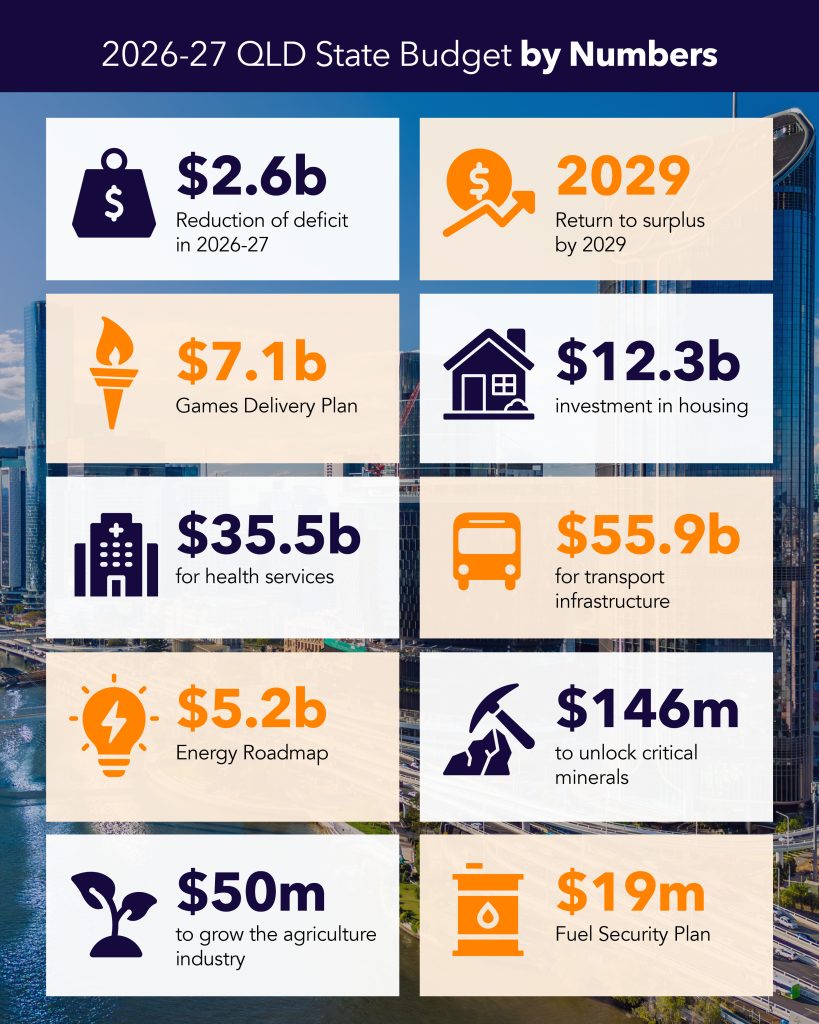
The defining feature of the Budget is a record $119.2 billion capital program over four years, positioning infrastructure as the primary driver of economic growth and productivity. This includes $55.9 billion for roads and transport infrastructure, significant investments in schools, hospitals and housing, and substantial funding for water security projects. Queensland’s population growth requires generational infrastructure investment, and the State intends to continue building through wider global economic uncertainty.
Health remains one of the Government’s highest political and policy priorities. The Budget delivers a record $35.5 billion health allocation, including funding for three new hospitals, ten hospital expansions and more than 2,600 additional beds. The Government is seeking to address long-standing concerns around ambulance ramping, elective surgery waitlists and regional healthcare access, while demonstrating visible progress on one of the key issues that contributed to its election victory.
Cost of living remains the dominant concern for Queensland households and the Budget responds with what the Government describes as the largest ongoing cost of living package in Queensland history. Key measures include permanent 50 cent public transport fares, a 50% increase in the Back to School Boost, $200 Play On! Sports Vouchers, continued electricity rebates and a two-year freeze on bulk water prices in south east Queensland, with the focus is on structural support measures rather than one-off payments.
The Government’s energy policy is focused on affordability, reliability and energy security. The $5.2 billion Energy Roadmap, lower projected electricity prices, $146 million for critical minerals development and the new $19 million Fuel Security Plan all reinforce the Government’s focus on maintaining Queensland’s competitiveness while supporting long-term investment.
Housing has emerged as a major policy priority, with $12.3 billion committed to housing initiatives and a record $5.7 billion Social and Community Housing capital program. The expansion of the Residential Activation Fund highlights the Government’s focus on increasing housing supply through enabling infrastructure.
Community safety continues to be a defining political issue. The Budget allocates $7.2 billion towards safety initiatives, including more than $250 million for child protection reforms, $80 million for Circuit Breaker Sentencing programs, additional police recruitment and significant investment in youth justice and victim support services. These measures reinforce the Government’s commitment to making community safety a central pillar of its first term.
The Brisbane 2032 Olympic and Paralympic Games have also moved decisively into the delivery phase. The Budget includes a $7.1 billion multi-year commitment, through the Games Delivery Plan, with $765 million in 2026-27 to progress the Brisbane Stadium, athlete villages and venue infrastructure. Increasingly, the Government is presenting the Olympics as a state-building opportunity focused on infrastructure, housing, urban renewal and international investment attraction.
Perhaps the most surprising aspect of the Budget is the Government’s confidence in Queensland’s fiscal outlook. Despite record investment commitments, the Budget forecasts lower deficits and reduced debt compared to previous projections. This is being driven by stronger revenue growth, expenditure restraint, procurement savings and tighter management of capital projects. The operating deficit is forecast to improve from $8.8 billion in 2025-26 to $6.2 billion in 2026-27, with a return to surplus projected by 2029-30.
Overall, the 2026-27 Budget demonstrates a government focused on delivering visible outcomes in health, infrastructure, housing and community safety while positioning Queensland for long-term growth. For business, the strongest opportunities continue to sit across infrastructure, energy, housing, healthcare, water security and Olympic-related projects, all of which are receiving substantial policy attention and financial investment.
Reach out to our Brisbane team if you would like to discuss the Queensland Budget and what it means for you.
Jamin Smith, Partner and Brisbane Office Head – [email protected]
Nicholas O’Connor, Associate Partner – [email protected]


SEC Newgate’s integrated approach draws on our national team’s experience and networks to deliver a full service offering.